
Faculty Professional Development Plan and Work Group
The Faculty Professional Development Work Group will serve as the strategic convener of this ecosystem. Co-chaired by the Chancellor’s Office and the Academic Senate for California Community Colleges (ASCCC), and including representatives from Chief Instructional Officers (CIOs), AI Faculty Fellows, CVC@One, the Vision Resource Center, regional consortia, OERI, and experts in accessibility, information literacy, and instructional design, this cross-functional body ensures that faculty are not just supported, but empowered to lead.
The Faculty Professional Development Plan was created in collaboration with our partners within the Faculty Professional Development Work Group. Aligned with Vision 2030, this work plan builds systemwide faculty capacity to drive equitable student success, integrate emerging technologies, and align programs with workforce needs. It positions faculty as leaders in creating inclusive, future-ready learning environments that expand opportunity for all students.
Key Strategies for Teaching and Learning
- Advance disciplinary innovation through faculty support, engagement, and community-building.
- Scale and strengthen regional networks to ensure the sharing and equitable, locally relevant professional learning opportunities.
- Expand access to affordable, accessible, and workforce-aligned instructional technology and tools.
- Build shared infrastructure for resource curation, mentorship, and continuous improvement.
- Integrate AI literacy and ethics into foundational training across roles and disciplines
By empowering faculty to lead in a changing technology landscape, as well as striking a purposeful balance between systemwide learning, regional responsiveness, and disciplinary innovation, this plan creates space for both consistency and creativity to advance Vision 2030 goals of equitable access, success, and economic mobility for California’s students. Through shared leadership and aligned efforts across colleges, roles, and regions, California’s community colleges will transform professional development into a force for equity and future-ready teaching and learning.
Strategic Framework for Faculty Development
This strategic framework for faculty development advances a comprehensive and sustainable approach to professional learning across the system, ensuring that opportunities are accessible, relevant, and aligned with Vision 2030 priorities. By combining scalable infrastructure, discipline-informed innovation, and regionally grounded collaboration, the plan supports faculty in continuously evolving their teaching practices to meet the needs of diverse students and a changing workforce. It emphasizes flexibility, inclusivity, and responsiveness, positioning faculty as leaders in advancing equity and innovation across California Community Colleges.
The plan is organized around three core approaches:
- Systemwide Learning: Provides accessible, high-quality professional development through centralized resources, scalable programming, and flexible formats to ensure consistency and broad reach.
- Disciplinary Domains and Innovation: Supports faculty in exploring how their fields are evolving and adapting pedagogy and assessment within discipline-specific contexts.
- Regional Responsiveness: Strengthens locally relevant professional learning through regional networks that foster collaboration, address shared challenges, and support innovation across diverse college contexts.
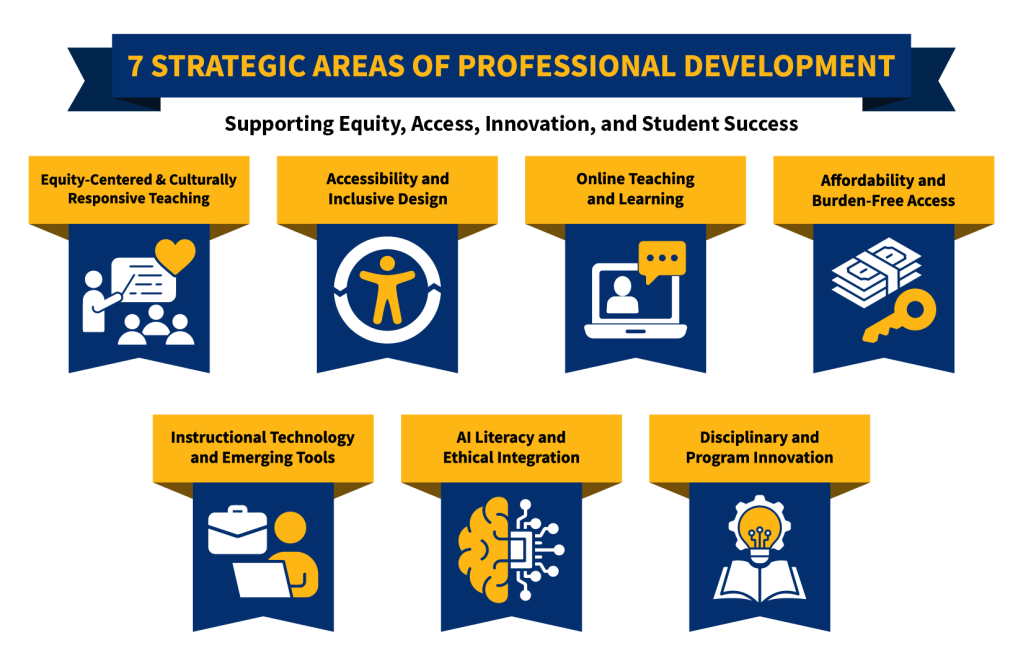
- Equity-Centered and Culturally Responsive Teaching
- Accessibility and Inclusive Design
- Online Teaching and Learning
- Affordability and Burden-Free Access
- Instructional Technology and Emerging Tools
- AI Literacy and Ethical Integration
- Disciplinary and Program Innovation