Conversation highlighted California Community Colleges’ work to empower students and faculty to build, create, and learn with AI while advancing responsible use
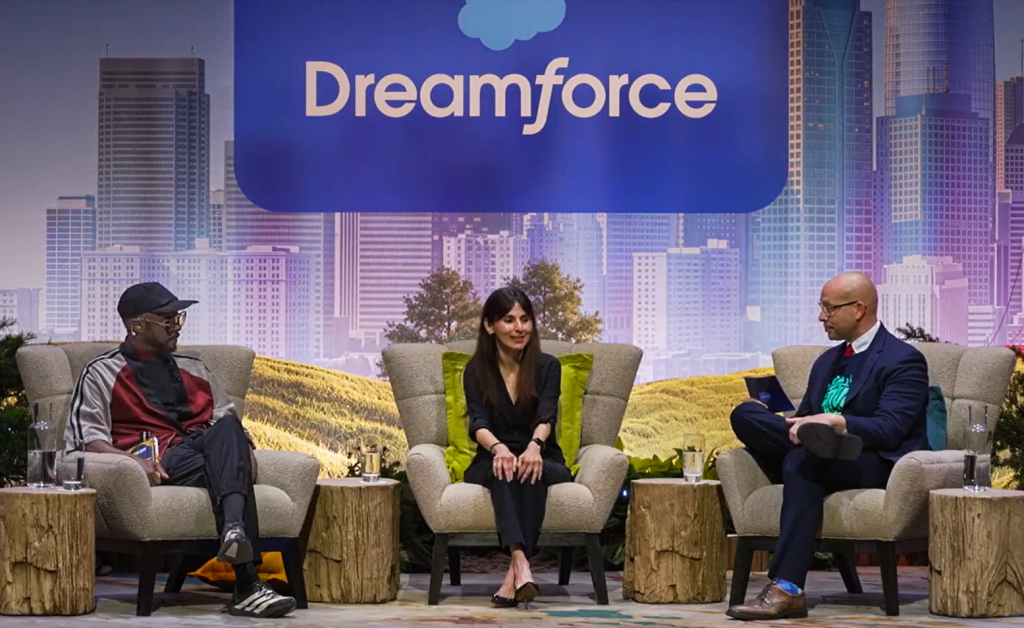
SAN FRANCISCO, Calif. — As colleges and employers navigate an increasingly AI-driven economy, California Community Colleges Chancellor Sonya Christian joined will.i.am, founder and CEO of FYI.AI, and Ron Smith, vice president of Philanthropy at Salesforce, (all pictured below) at Dreamforce 2026 for a featured conversation on the evolving role of artificial intelligence in education and the opportunities it presents for teaching, learning and preparing students for a changing world of work. A recording of the full Dreamforce 2026 conversation is available on the Salesforce website.
Dreamforce panel pictured left to right: will.i.am, Chancellor Sonya Christian, Ron Smith
The conversation, which took place last week, comes as the California Community Colleges Chancellor’s Office (Chancellor’s Office) is advancing a distinctly human-centered approach to AI across the nation’s largest system of higher education, serving more than 2 million students.
At the center of the Chancellor’s Office approach is the principle that, as artificial intelligence becomes more capable, the people we serve should become more capable too.
That means preparing students to move beyond simply consuming what AI produces and giving them opportunities to build, create, and solve problems in collaboration with AI. It also means investing in faculty so educators have the time, professional development, and support to experiment with these technologies and redesign teaching and learning for a world in which AI will be increasingly present.
The work is paired with clear guardrails around responsible use, including data privacy, security, transparency and ethical decision-making.
“AI should make our students more capable, more creative, and more confident in their own judgment,” said California Community Colleges Chancellor Sonya Christian. “That is the opportunity in front of us. We want students building with these tools, questioning them, and creating things they could not create before. And we want faculty leading that work, with strong guardrails around privacy, security, and responsible use. This is ultimately an investment in people—in their agency and their ability to shape what comes next.”
Learning From Students and Faculty
With philanthropic support from Salesforce, the Chancellor’s Office has been testing student-centered approaches to AI and learning and, just as importantly, listening directly to students and faculty about what they need.
The early work found that students are curious about AI and eager to experiment with it, while also asking for structure and guidance. Students identified a desire for hands-on practice, clear guidance on ethical and effective use, and stronger critical-thinking skills that help them remain in control when AI is present in educational and professional settings.
Students also demonstrated what becomes possible when they are given opportunities to create with the technology. One student used AI while building an autonomous underwater vehicle, breaking complex technical challenges into manageable steps. Another learned new technical skills with AI and built a QR-code system for a campus center. Students said AI helped them become more independent learners, take creative risks, and gain confidence in their ability to solve problems.
At the same time, students raised concerns about overreliance on AI, the loss of critical-thinking skills, the effects on creativity, and the uncertainty about how AI will reshape their careers.
Putting Faculty at the Center
Faculty professional development is another central element of the Chancellor’s Office strategy.
Faculty participating in the Salesforce-supported work explored how teaching itself may need to evolve as AI becomes increasingly available. Their ideas included moving toward project-based and critical-thinking assignments, teaching students to ask better questions, using AI as a starting point for creativity rather than a finished product, incorporating purposeful prompting, and having students actively test and critique AI-generated work.
The work also surfaced barriers. Faculty identified the rapid pace of technological change, limited time to explore new tools, uneven AI literacy, and uncertainty about how to design effective AI-integrated assignments. Those findings help inform the Chancellor’s Office approach to professional development and faculty-led experimentation.
“Our faculty know what learning looks like,” Christian said. “We need to give them the time, tools, and space to experiment and figure out where AI can deepen learning and where we need to protect the thinking, relationships, and judgment that education develops. Faculty need to lead that conversation.”
Exploring What Comes Next
At Dreamforce, Christian and will.i.am also explored the emerging possibilities of agentic AI in education.
FYI.AI’s EDU.FYI platform and its concept of an “Agentic Self” explore a model in which an AI persona learns alongside a student over time while reflecting the student’s values, voice, and goals, shifting the interaction from a tool that simply responds to prompts toward a more personalized and collaborative relationship.
will.i.am, also a professor of practice at Arizona State University who will be teaching “The Agentic Self” course again this fall, discussed how his passion to help transform lives by preparing people for the future so they can contribute and add value to their communities aligns with Chancellor Christian’s. And why access to the latest tools and technologies is so important for community colleges.
“Either you create the movement, are part of the movement, or you get moved. I think right now is the time that the community colleges and these underserved communities become their own developers,” said will.i.am, founder and CEO of FYI.AI during the Dreamforce session. “The community colleges are important and those residents and students, they know firsthand what those problems (in their area) are. And if they’re given the tools and the encouragement, they can solve the problems of their communities themselves.”
Material from “The Agentic Self” course was incorporated into a course offered at a California community college during Summer 2026. The course was titled, “Generative AI Foundations,” and was taught at Evergreen Valley College in San Jose.
Salesforce’s philanthropic support has provided the Chancellor’s Office with opportunities to engage students and faculty directly, test emerging approaches, and gather evidence that can inform future work across California’s community colleges.
“The future is what everyone needs to talk about. Young people are changing. Systems are changing. And the only way we can keep up with that change is by ensuring we step in and give back,” said Ron Smith, vice president of Philanthropy at Salesforce, during the Dreamforce session. “Education is the key. Remember, it’s part of the future.”
The Salesforce-supported pilot points to additional work, including expanding student-centered AI and career-readiness workshops, supporting faculty through train-the-trainer and continuous-learning models, gathering student perspectives to inform system decisions, and advancing ethical AI literacy.
The Chancellor’s Office is also applying this learn-by-doing approach across a broader portfolio of emerging-technology initiatives, including immersive learning, AI-supported opportunities for students to practice communication skills, and professional development that gives faculty opportunities to explore how emerging technologies can strengthen teaching and learning.
The Dreamforce conversation follows the California Community Colleges’ third annual Futures Summit, held Sept. 9-10 in Santa Clara, where educators, students, employers, technology innovators and national leaders explored the implications of AI and other emerging technologies for learning, work and society.
The work builds on Vision 2030, which established Artificial Intelligence and the Future of Teaching and Learning as a strategic direction for the California Community Colleges.
The California Community Colleges is the largest system of higher education in the nation, composed of 73 districts and 116 colleges serving 2.2 million students per year. California community colleges provide career education and workforce training; guaranteed transfer to four-year universities; and degree and certificate pathways. As the state’s engine for social and economic mobility, the California Community Colleges supports the Vision 2030, a strategic plan designed to improve student success, our communities and our planet. For more information, please visit the California Community Colleges website or follow us on Facebook, Instagram and X (formerly Twitter).