
The CAST UDL Guidelines
The CAST UDL Guidelines are a research-based tool that helps educators design learning environments that are accessible, inclusive, and challenging for all learners:
- They provide concrete, flexible suggestions for curriculum design.
- They focus on proactively reducing barriers in the design of learning — not fixing learners.
- The ultimate goal is to develop learner agency that prepares students for lifelong learning and adaptability to meet the needs of a rapidly changing world.
Learners who have agency are:
- Purposeful: They believe in themselves and stay motivated because their learning matters to them and to others.
- Reflective: They think about how they learn, understand what helps or gets in the way, and make changes when needed.
- Resourceful: They use their strengths, experiences, culture, language, and available tools to support their learning.
- Authentic: They learn in ways that feel real and meaningful, and can apply their learning to everyday life.
- Strategic: They set goals, make plans, and keep track of their progress as they learn.
- Action-oriented: They take initiative—on their own and with others—to reach their learning goals.
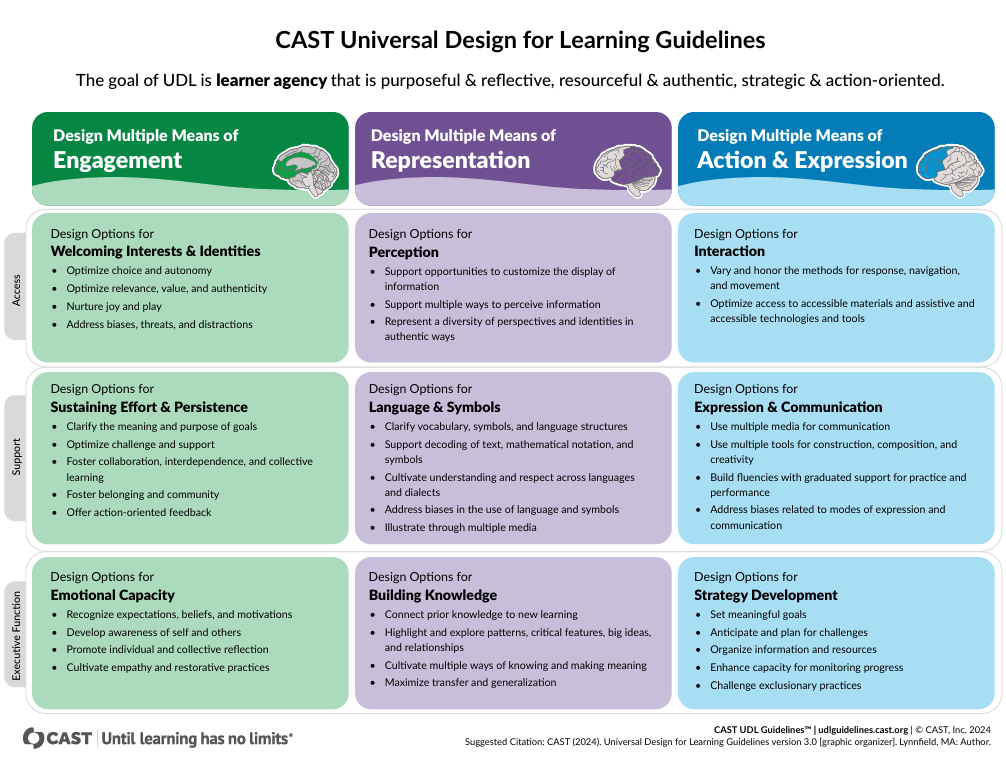
CAST (2024). Universal Design for Learning Guidelines version 3.0 [graphic organizer]. Lynnfield, MA: Author
The Structure of the UDL Guidelines
The UDL Guidelines are organized into a 3-level structure: principles, guidelines and considerations.
1. Principles (The Big Ideas)
|
Principle |
Focus |
Description |
|---|---|---|
|
Engagement |
The “why” of learning |
Recruiting interest, sustaining effort and building emotional capacity |
|
Representation |
The “what” of learning |
Presenting information in different ways to support comprehension and knowledge building |
|
Action and Expression |
The “how” of learning |
Allowing multiple ways to demonstrate learning through interactions with the learning environment and other learners |
Identity (the “who”) of learning is considered throughout UDL Guidelines 3.0. Connecting learning to the lived experiences of learners improves motivation and supports understanding by making learning more relevant and meaningful.
2. Guidelines (Design Priorities). Each principle is broken into guidelines that highlight key areas for design. Examples include:
- Engagement: design options that welcome learners’ interests and identities, sustain their effort and persistence, and build emotional capacity.
- Representation: design options that support learners’ perception, understanding of language and symbols, and ability to build knowledge.
- Action & Expression: design options for interaction, expression and communication, and strategy development.
These guidelines are organized into 3 layers that represent a transfer of responsibility for and ownership of learning:
- Access: creates an accessible, safe and welcoming environment that sets the optimal conditions for learning
- Support: provides tools and resources to help learners take accessible information and build meaning from it
- Executive functioning: builds life-long learning skills and understanding of self and others in order to make learning sustainable
3. Considerations (Actionable Strategies). Each guideline includes specific, research-based considerations that provide practical ways to reduce barriers. Examples include:
- Nurture joy and play by: incorporating storytelling, arts-based practices and opportunities for exploration and play.
- Support multiple ways to perceive information by: Providing text or spoken descriptions of visuals, following accessibility best practices when creating digital text, and providing captions and transcript for videos.
- Enhance capacity for monitoring progress by: using prompts to encourage reflection and self-monitoring, using checklists/rubrics/models learners can use to evaluate their own work.
Overall, the structure includes:
3 Principles
9 Guidelines
30+ Considerations
Other than the three principles, you don’t have to memorize all of this information. You can download the CAST UDL guidelines in a variety of formats for use as you design or redesign learning.